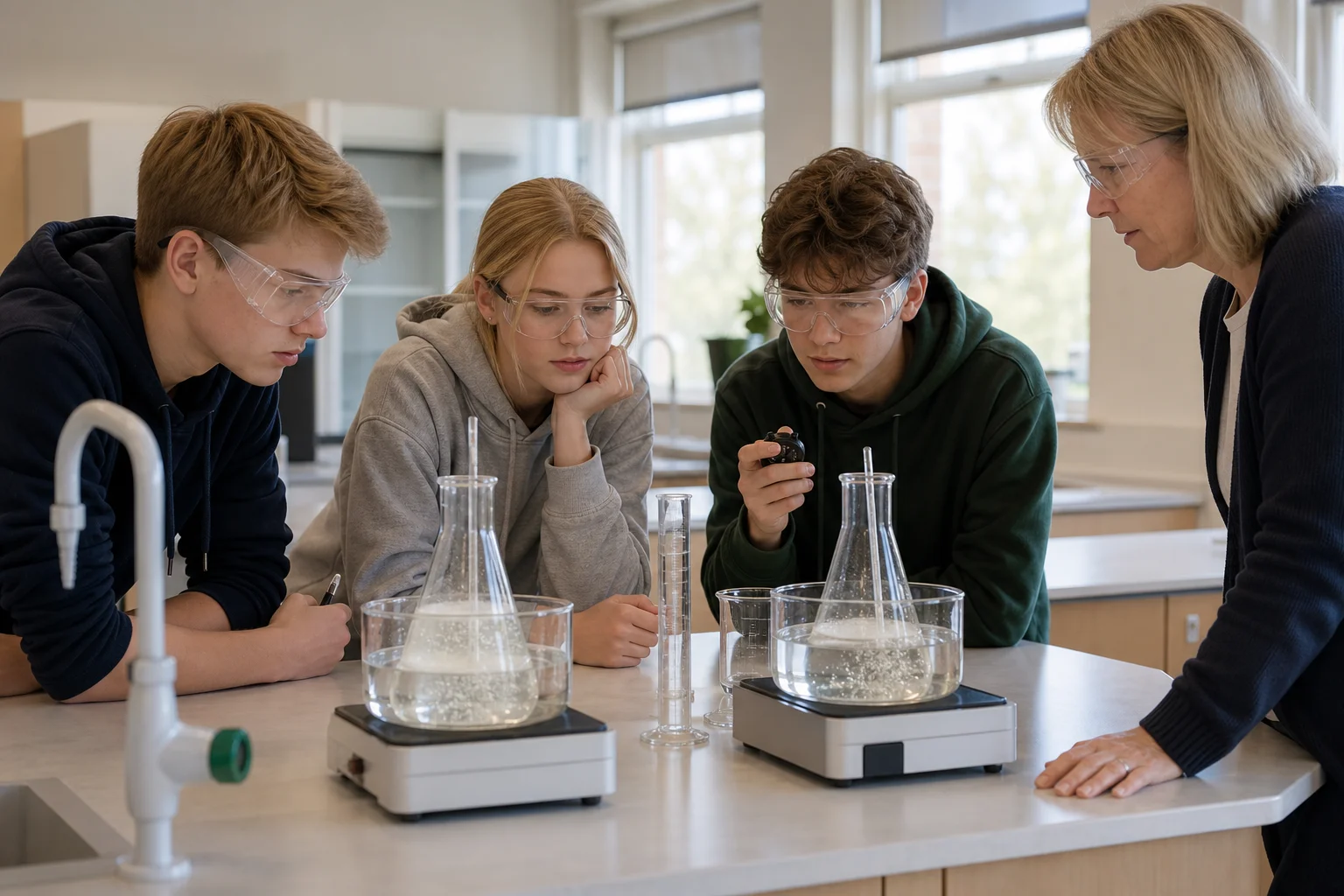
Before the practical work
Collect a prediction and particle-level reason before the outcome makes the first question look obvious.


Explore practical ways to build, run, and review learning with Praktikal.
Chemistry asks students to move between what a reaction looks like, what the data shows, what particles are doing, and what an equation represents. Keep those levels in one Praktikal lesson, with responses visible while there is still time to revisit the model.
Use one sequence to connect the visible reaction, measured pattern, particle account, and symbolic equation without pretending they form an automatic pipeline.
Collect a prediction and particle-level reason before the outcome makes the first question look obvious.
Keep measurements, observations, conditions, and safety prompts in one structure students can follow.
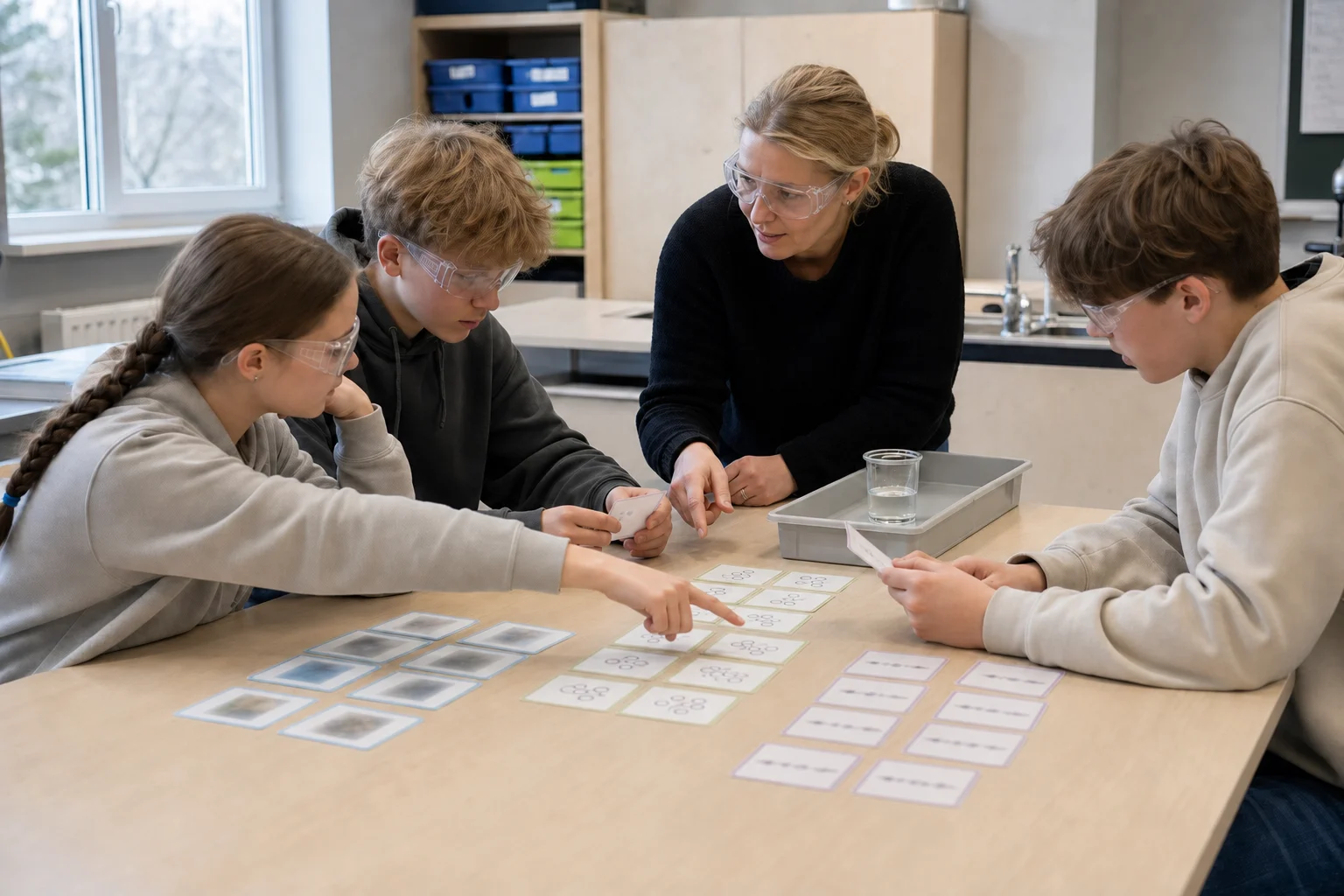
Ask students to connect collision, arrangement, or energy to the pattern they observed in the data.
Check that the symbols summarise a chemical explanation rather than becoming an isolated balancing exercise.
Explore concrete teaching sequences and the Praktikal tools that connect observations, equations, quantities, particle models, and student explanations.
Keep the macroscopic, particle and symbolic levels distinct enough to think with – and close enough to connect.
Read articleKeep the chemistry visible while pupils move from coefficients to quantities and a checked, interpretable answer.
Read articleChoose the exact symbols, subscripts, charges, coefficients, or states learners must complete.
Explore featureCollect amount calculations and formula-based answers with mathematical input and structured working.
Explore featurePlot rate or measurement data and ask learners to interpret or construct the graph.
Explore featureCreate editable particle models, apparatus diagrams, and linked representations.
Explore featureLet learners annotate apparatus, observations, or particle diagrams directly.
Explore featureCompare predictions and explanations before moving from observations to the chemical model.
Explore featureBring experiments, measurements, particle models, equations, and feedback into one Praktikal lesson.
No credit card required.
Teacher feedback
Good. Add that (aq) marks dissolved species; the representation still omits water and the scale of separation.