

Keep the thinking connected
When a physics practical is intended to develop understanding, it needs a line of thought running through it. Pupils should know what question they are investigating, what their measurements will tell them and how the resulting pattern relates to a physical idea.
Move from the investigatory question to a reasoned prediction, purposeful measurement, an evidence check, a physical explanation, revision and the next teaching move.
A teacher can set the investigatory question and practical procedure while still giving pupils meaningful decisions about predictions, evidence and explanations. Research on secondary science practical work suggests that the difficult step is often the connection between what pupils observe and the scientific ideas the activity is meant to develop.
The sequence below can be adapted to an investigation in which pupils test a relationship between two quantities. It is a teaching structure rather than a complete experiment plan. You will still need to supply the apparatus, timings, procedure, safety controls and subject-specific adaptations.
Praktikal can hold lesson content and question blocks, collect answers during a live lesson, show the teacher answers and progress, support feedback and make the material available for later adaptation. Use response types and views that you have confirmed in your current Praktikal setup. The platform connects the stages, but the teaching decisions remain yours.
Prediction → measurement → evidence → explanation → revision → decision
- 01Question + prediction
Make the starting idea visible. Ask what pupils expect—and why.
- 02Plan the measurement
Give every reading a purpose. Connect quantities to the question.
- 03Check the evidence
Pause while another reading can still improve the evidence.
- 04Explain the pattern
Connect the data pattern to the relevant physical idea.
- 05Compare + revise
Return to the prediction. Test explanations against the data.
- 06Decide next
Question, model, repeat or adapt.
Start with a question and a reasoned prediction
State the investigatory question before pupils handle the apparatus. Then ask them to commit to a prediction and a reason.
A closed prediction question is the most clearly verified starting point in Praktikal. The options might describe several plausible relationships between the two quantities, including a common alternative idea. Avoid scoring the prediction as though it were a recall test. Its job is to make pupils’ starting ideas visible so that the class can test and revisit them.
A prediction without a reason tells you little about the thinking behind it. If your current Praktikal setup has a suitable response type, add a follow-up prompt for the reason. If it does not, collect the reasoning through discussion or pupils’ usual written work.
- Teacher decision
- Which prediction would distinguish the ideas you most need to hear?
- Evidence to look for
- The spread of predictions and the reasons pupils give for them.
Give every measurement a job
Before pupils collect readings, connect the recording plan to the question. Identify the quantity to vary, the quantity to measure, the controls to maintain, the units to use and the reason for taking repeated readings where the chosen practical calls for them.
Ask pupils what pattern would answer the investigatory question and what readings would allow them to see it, rather than asking only what goes in each column.
A Praktikal data-table question lets each pupil or group enter its own measurements in editable cells. The teacher can then review the submitted tables in the results view. This is not one shared spreadsheet that every group edits at once. Content and question blocks can carry the instructions and check whether pupils understand which variable changes, which is measured and what should remain controlled.
[1]- Teacher decision
- What must pupils understand about the measurements before they start?
- Evidence to look for
- Whether pupils can explain why each reading is needed, rather than merely follow the table headings.
Pause while the evidence can still change the practical
Build in a pause after the first useful set of readings, while pupils can still take another measurement. This checkpoint is for evidence quality, not safety. Unsafe work stops immediately under the teacher’s established procedure and supervision.
Ask pupils to check whether the pattern is consistent, whether a value looks surprising and whether they have enough evidence to answer the question. Pupils should record and investigate a surprising value rather than remove it automatically. The teacher defines what counts as sufficient evidence for the chosen practical.
A short Praktikal check can collect a decision such as “continue”, “repeat a reading”, “investigate a surprising value” or “pause”. During a live lesson, teachers can see answers and progress as responses arrive.
Treat the response as formative evidence when it informs what happens next. Depending on the practical and the evidence available, you might ask one group to repeat a reading, pause the class to clarify a control or let pupils proceed when your wider checks suggest that the evidence is sufficient.
[1] [4]- Teacher decision
- Should the class continue, repeat, investigate or pause?
- Evidence to look for
- Pupils’ decisions about surprising values, consistency and missing evidence.
Move from a pattern to a physical explanation
Once pupils have enough evidence for the chosen practical, return to the original question. Ask for three connected parts: a claim that answers the question; the pattern in the data that supports it; and the physical idea that explains the pattern.
Describing a graph or repeating a trend is not, by itself, a physical explanation. Pupils need prompts that help them connect the observable result to the relevant physical model, and some will need the teacher to model that connection explicitly.
Choose the response method to match the explanation. A short free-text check in Praktikal uses answer-key matching, so it suits concise answers with anticipated alternatives rather than open scientific reasoning. For extended submitted work, use a manually graded response such as an upload, or let pupils complete the explanation in their usual notebook and use Praktikal for the prompt and evidence-selection check. Praktikal should not be presented as automatically judging the quality of a scientific explanation.
- Teacher decision
- Which distinction will help pupils move from describing the data to explaining it?
- Evidence to look for
- A claim, selected evidence and reasoning that uses an appropriate physical idea.
Compare the result with the prediction
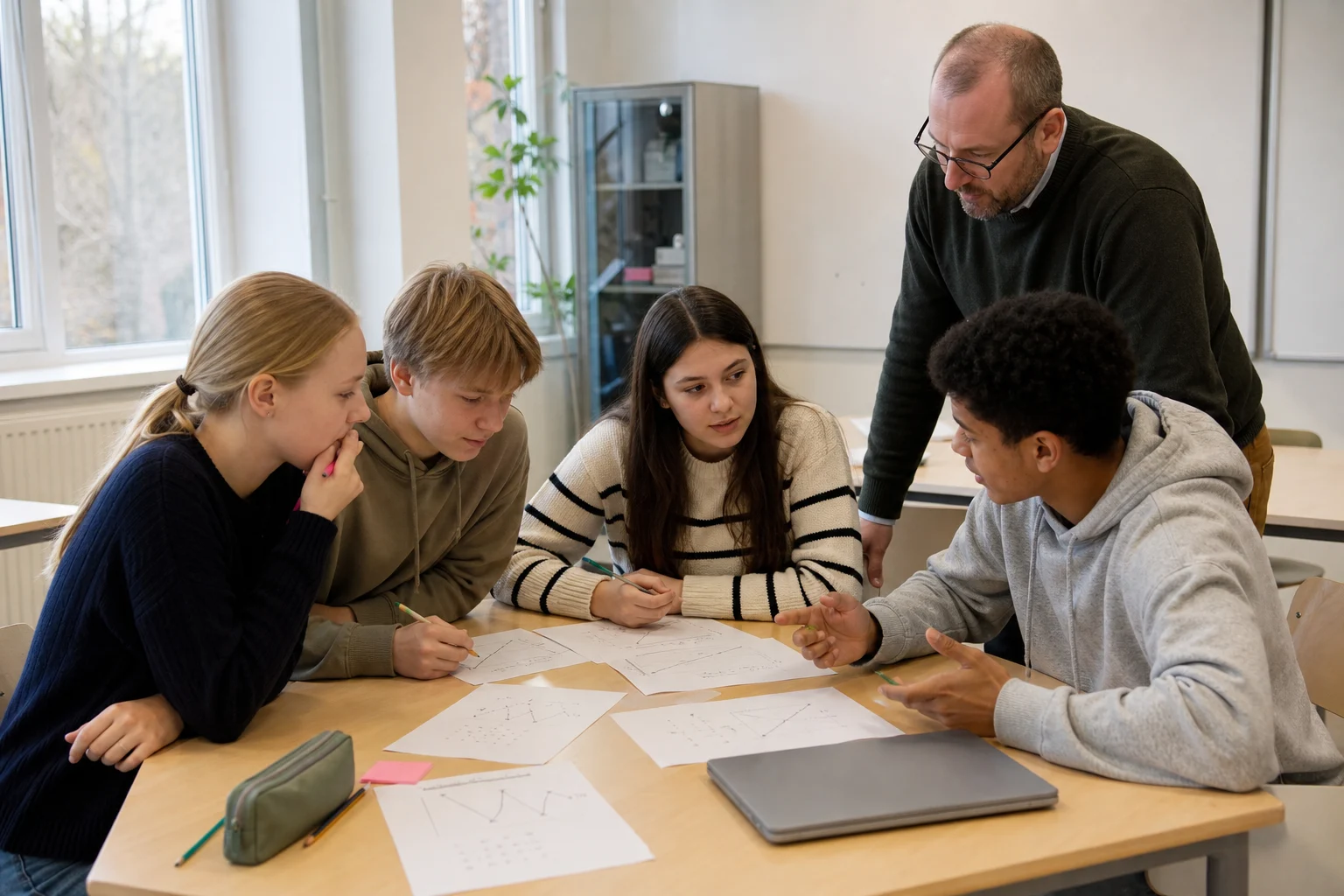
Bring the first question back. Ask pupils to compare their original prediction with the evidence and decide whether to retain, revise or qualify their explanation.
Choose contrasting answers that expose different interpretations of the same pattern. Ask pupils which interpretation the data support, what remains uncertain and what additional evidence would help. Research on science discussion warns against assuming that talk becomes productive by itself; pupils often need clear cues and teacher support to compare claims and evidence.
Praktikal’s live answers can help you see which options pupils selected, and feedback can be given during or after the lesson. Before displaying any pupil response to the class, use a privacy-safe view and follow your school’s expectations for sharing work.
- Teacher decision
- Which contrast is worth discussing, and what should pupils revise afterwards?
- Evidence to look for
- Changes between the initial prediction and the revised account, including points pupils still cannot explain.
Use the responses to choose the next move
End by deciding what the evidence calls for. The next step may be another measurement, a worked explanation, a question for the whole class or a later task that tests whether pupils can use the idea in a different situation.
Praktikal allows teachers to respond during a lesson or leave feedback later. Closed questions can be scored automatically and reviewed by the teacher, but an automatically scored answer should not be treated as an automatic judgement of scientific reasoning. Teachers can reuse their own material and adapt material they have permission to derive.
Adapt the prediction, evidence check and explanation scaffold to the practical you are teaching.
A compact planning checklist
Before teaching, check that the sequence answers these questions:
- What is the investigatory question?
- Which prediction will make pupils’ starting ideas visible?
- Why is each measurement needed?
- When will pupils check the quality and sufficiency of their evidence?
- How will they connect a claim, a data pattern and a physical idea?
- When will they compare the result with their prediction?
- What response would make you change the next teaching move?
The checklist is independent of one named experiment. It can help you improve an existing physics practical without pretending to supply its apparatus, method or safety guidance.
[1] [4]- Teacher decision
- What should you question, model, repeat or extend next?
- Evidence to look for
- The change pupils make after feedback and the ideas that still need attention.
Source notes
Education Endowment Foundation, Improving Secondary Science (2018) Evidence-informed guidance for KS3 and KS4 science; it supports purposeful practical work, diagnostic questions, explicit links between observations and scientific ideas, and feedback that pupils can act on.
Ian Abrahams and Robin Millar, Does Practical Work Really Work? (2008) Qualitative study of 25 practical lessons in English secondary schools; it does not estimate the effect of this six-stage sequence.
Ping-Kee Tao and Richard F. Gunstone, The process of conceptual change in force and motion during computer-supported physics instruction (1999) Small, simulation-based Grade 10 study; it supports cautious use of predict-observe-explain, not a claim of durable change.
Paul Black and Dylan Wiliam, Assessment and Classroom Learning (1998) Broad formative-assessment review, used here for the principle that elicited evidence must inform subsequent action. The research pack inspected the indexed abstract and bibliographic record rather than the full paper.
Judith Bennett and colleagues, Talking Science: The research evidence on the use of small group discussions in science teaching (2010) Systematic review supporting structured discussion cues and teacher support; the research pack inspected the indexed abstract and bibliographic record.
Erin Marie Furtak and colleagues, Experimental and Quasi-Experimental Studies of Inquiry-Based Science Teaching: A Meta-Analysis (2012) Broad, heterogeneous science-inquiry evidence supporting purposeful teacher guidance rather than unguided discovery. The research pack inspected the published abstract and metadata.