

A source pack becomes an enquiry when pupils use details from authentic sources to answer a bounded question, test a provisional claim, state what the evidence cannot establish and revise after teacher feedback.
Choose one setting below. Manchester is the expanded worked example; Narva/Kreenholm, Essen/Krupp and Turin/Lingotto are compact alternatives. You can transfer the method between settings, but conclusions remain specific to each place. This does not claim curriculum alignment: check the topic, phase, source language and assessment expectations locally.
[1]The seven moves that stay fixed
- Context: supply a concise modern synthesis, labelled as context rather than primary evidence.
- Orientation: order only the dates needed to understand source creation, publication and transmission.
- Provenance: keep creator, title, date, repository, locator, translation/transcription responsibility and rights beside each source.
- Source notes: ask for one detail, one inference and one form/position/purpose limit.
- Claim test: sort details under
supports / qualifies / cannot establish. - Qualified answer: use at least two sources and name one limit.
- Omission and revision: reveal a missing perspective or contextual fact, give teacher feedback and ask for a narrower answer.
Build these moves as ordered worksheets inside one Praktikal lecture. Use the live Q&A during source discussion to surface questions about provenance and evidence limits, then collect the individual claim for teacher feedback and revision. Praktikal does not authenticate or translate sources, corroborate claims, or grade historical judgement.
[1]Expanded worked example – Manchester, 1840s–1850s
Enquiry: What can two contrasting representations tell us about Manchester's built environment and social divisions in the 1840s–1850s?
Give just enough context
Use a short paraphrase of the Science and Industry Museum's The world's first industrial city: Manchester's cotton-led expansion connected it to global manufacturing and trade, while innovation and profit coexisted with exploitation. Label this modern context; the page does not authenticate the two primary sources or license museum images.
Orient pupils to four moments: Engels's observations in 1844; German publication in 1845; Wyld's panorama in 1852; Wischnewetzky's English translation in 1887. These dates locate source production and transmission rather than explain city change.
Present two exact sources
Source A: William Wyld, Manchester from Kersal Moor, with rustic figures and goats, 1852, Royal Collection, RCIN 920223. Use the full panorama, with no crop. The Wikimedia Commons Google Art Project record marks the work public domain, attribution not required and not copyrighted. Ask what the elevated composition makes visible about skyline, density, routes, smoke and scale, while distinguishing represented features from city-wide prevalence.
Source B: Friedrich Engels, The Condition of the Working Class in England in 1844, observations made in 1844, German publication 1845, Florence Kelley Wischnewetzky's New York English translation 1887. Use the Commons scan derived from Internet Archive, printed p. 32; physical PDF p. 50 of 234. The extract describes Manchester’s commercial centre and surrounding working-class districts.
“Manchester contains, at its heart, a rather extended commercial district, perhaps half a mile long and about as broad, and consisting almost wholly of offices and warehouses.”
“With the exception of this commercial district, all Manchester proper, all Salford and Hulme, a great part of Pendleton and Chorlton, two-thirds of Ardwick, and single stretches of Cheetham Hill and Broughton are all unmixed working people's quarters, stretching like a girdle averaging a mile and a half in breadth, around the commercial district.”
What the sources show — and what they cannot establish
Use details from each source, then keep the claim within its evidence.
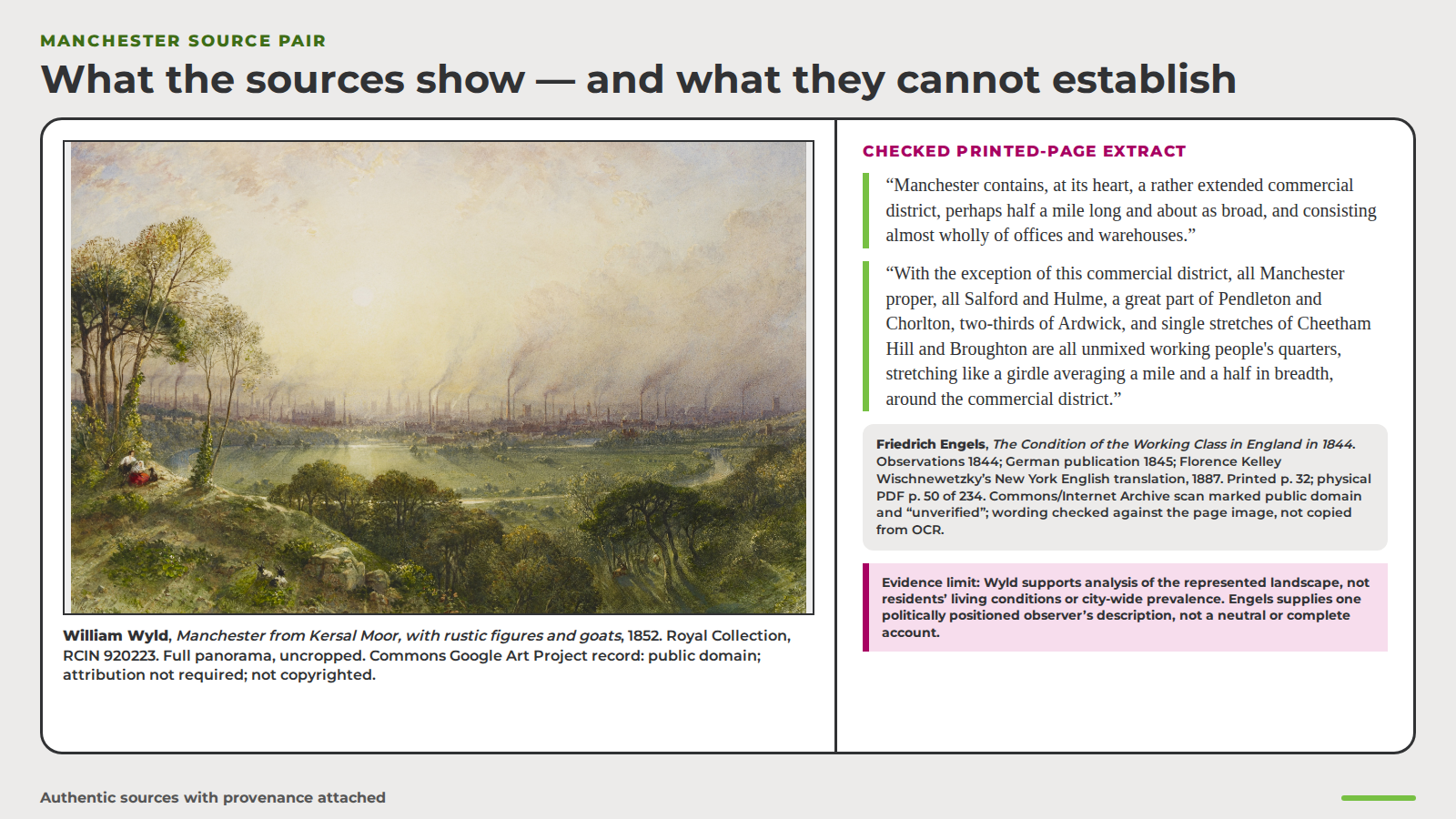
William Wyld, Manchester from Kersal Moor
- Date
- 1852
- Repository
- Royal Collection · RCIN 920223
- View
- Full panorama, uncropped
- Rights
- Public domain
Friedrich Engels on Manchester
“Manchester contains, at its heart, a rather extended commercial district, perhaps half a mile long and about as broad, and consisting almost wholly of offices and warehouses.”
“With the exception of this commercial district, all Manchester proper, all Salford and Hulme, a great part of Pendleton and Chorlton, two-thirds of Ardwick, and single stretches of Cheetham Hill and Broughton are all unmixed working people's quarters, stretching like a girdle averaging a mile and a half in breadth, around the commercial district.”
- Work
- The Condition of the Working Class in England in 1844
- Edition
- Florence Kelley Wischnewetzky’s New York English translation, 1887
- Locator
- Printed p. 32 · physical PDF p. 50 of 234
Use the two sources as evidence
For each source, ask: Which detail matters to the question? What might it support? Which feature of the source's form, position or purpose limits that inference? Then test:
Manchester was represented as an impressive connected industrial landscape.A commercial centre was described as spatially separated from many working-class districts.
Wyld can support observations about the represented landscape but not residents' living conditions. Engels can support a claim about one politically committed observer's description but not its prevalence or neutrality. Together they cannot explain industrialisation, women's work, domestic interiors, municipal governance or the full global cotton network.
During the live source reveal, invite anonymous pupil questions. Highlight questions about viewpoint, translation, provenance or evidence limits; answer them from the checked pack or park them when the supplied evidence cannot resolve them. The Q&A surfaces pupils’ questions – it does not validate the sources.
Ask for a short answer using one detail from each source and an explicit limit. Review it, then reveal the omission: the selected pair does not adequately represent the global cotton and enslaved-labour network in the modern context. Pupils revise one over-general sentence.
[2] [3] [4]Choose one compact swap-in
Each pack below supports the same seven moves: establish context, inspect sources, separate detail from inference, test a claim, identify an omission, give feedback and revise.
Narva/Kreenholm, 1857–1912
Enquiry: How did selected contemporary representations present Kreenholm's founders, industrial landscape and growth between 1857 and 1912?
Context: paraphrase Maie Pihlamägi's full article Narva tööstus 1870–1940 on river power, rail connection, factory suburbs and textile predominance. Cite only; access does not license images or validate the trade report's figures.
Exact source pack:
- Unknown creator, Kreenholmi Manufaktuuri asutajad, 1857 – an image dated 1857 and reproduced in the company's 1907 anniversary album. Treat it as a later commemorative reproduction rather than a contemporary photograph.
- Unknown creator, Narowa-Wasserfall und Fabrik Kränholm, in Baltischer Kulturhistorischen Bilder-Atlas, 1886. The elevated river and factory view shows how the river, factory blocks and settlement were composed, but not interiors or working conditions.
- Ralph M. Odell, table of Krenholm growth, U.S. Congressional Serial Set, issue 6280, 30 June 1912, source page printed p. 34. The extracted table presents figures reported by a 1912 U.S. trade publication and should be read as that publication’s account.
Claim test: Kreenholm was represented through concentrated leadership and physical scale; growth was presented as measurable productive capacity.
Can support: how an anniversary publication foregrounded founders/managers; how an 1886 view composed river power, factory architecture and settlement; how a 1912 report represented growth through spindles, looms and yarn output.
Cannot support: worker identity or voice, wages, hours, safety, housing experience, causes of reported growth, audited accuracy, or neutral/typical representation.
Omission and revision: reveal that no worker-authored source appears and the set omits women's work and the settlement's ethnic composition documented in the modern context. Ask: Which sentence must become narrower once you identify who produced and preserved these sources?
Essen/Krupp, 1886–1917
Enquiry: How did published and visual sources present Krupp as both an industrial system and a force shaping Essen between 1886 and 1917?
Context: paraphrase the Ruhr Museum's 200 Jahre Krupp. Ein Mythos wird besichtigt, which frames Krupp through industrial expansion, labour, products, family/company myth, solidarity claims and failure. Cite only; the page supplies no reusable exhibition image.
Exact source pack:
- Jakob Scheiner, Arbeiterkolonie Kronenberg, 1886, watercolour. This is an artistic representation of the Krupp-built workers' colony, not a photograph or a record of interior conditions, rents or welfare effects.
- Captain E. Monthaye, “A Visit to the Krupp Works, at Essen”, translated from French by Captain Otho E. Michaelis in Alfred Krupp: A Sketch of His Life and Work, New York, 1888, printed pp. 49–50. The translated account is admiring: it calls the works “the pride of Germany”, Essen a “veritable hive of industry”, and credits Krupp for much of the city's prosperity.
- Bain News Service, Gun Shops, Krupps [i.e., Krupp], Essen, 1917. Library of Congress, George Grantham Bain Collection, call no. LC-B2-3306-10; whole glass-negative image. LOC states “No known restrictions on publication”. Visible shop organisation and scale may be described; wages, safety, attitudes and output may not.
Claim test: Krupp was presented as a city-shaping institution; industrial scale was represented as order, power and national prestige.
Can support: explicit admiration in Monthaye; different visual organisation in a colony watercolour and machine-hall photograph; analysis of promotional, artistic and news-photographic framing.
Cannot support: worker agreement, everyday home/work conditions, wages, coercion, safety, industrial conflict, all Essen/the Ruhr/Germany, or simple continuity across 1886–1917.
Omission and revision: reveal that no worker-authored testimony or labour-conflict source appears. Ask pupils to rewrite one sentence so it describes what the sources present, not what all workers experienced.
Build the lesson: museum context → 1886/1888/1917 ordering → watercolour/extract/photograph panels → detail/inference/position notes → supports/qualifies/cannot-establish sort → two-source answer → teacher feedback → worker-voice omission → revision.
[9] [10] [11] [12]Turin/Lingotto, 1911–1939
Enquiry: How did a public poster and two Fiat-related photographs represent industrial modernity and organised work in Turin between 1911 and 1939?
Context: paraphrase Treccani's bounded statement that Lingotto was a Fiat plant from 1922 to 1982. If useful after the enquiry, add one sentence from the Italian Ministry of Culture record on later closure/reuse and the surviving rooftop track. Cite only; neither source licenses its images or supplies worker testimony.
Exact source pack:
- Poster attributed to Leopoldo Metlicovitz, printed by G. Ricordi & C., Exposition Internationale des Industries et du Travail – Turin 1911. Letterenhuis / Museum Vleeshuis object AV.38.5.10.186. The attribution remains uncertain, so preserve “attributed to” when discussing the poster.
- Unknown photographer, Fiat Lingotto accounting-office employees at calculating machines, 1923. Fiat thematic album 92; Sistema Archivistico Nazionale SAN:IMG-00001308. The archive identifies the office setting and calculating machines; the image cannot establish employees' pay, status, hours or attitudes.
- Photographer unidentified, Fiat 1100 assembly line at Lingotto, 1939. The photograph shows an assembly-line view, but cannot establish productivity, safety or labour relations.
Claim test: Turin's industrial identity was publicly staged before Lingotto opened; institutionally preserved Fiat images presented modern production as administrative and mechanical organisation.
Can support: the poster's public association of Turin with international industry/labour; institutional representations of office calculation and assembly-line organisation; comparison of poster design with archive photography.
Cannot support: feelings, earnings, safety, productivity, Fiat's importance to every part of Turin, labour policy, migration, strikes or gender relations without additional evidence.
Omission and revision: reveal that all three sources are public/institutional representations and none is worker-authored. Ask pupils to replace one general claim about “workers” with a precise claim about what a poster or photograph makes visible.
Build the lesson: Treccani context → 1911/1922/1923/1939 ordering → poster/two photograph panels → detail/inference/limit notes → supports/qualifies/cannot-establish sort → two-source answer → teacher feedback → institutional-selection omission → revision.
Source notes
Ofsted research review series: history A research review used for the distinction between substantive and disciplinary knowledge and for the role of chronology, evidence, interpretations and historical enquiry. It does not prescribe this lesson sequence.
The world's first industrial city Science and Industry Museum context for Manchester's cotton-led growth, global connections, innovation, exploitation and links to enslaved plantation labour. It is modern context, not a primary source or an image licence.
Manchester from Kersal Moor, with rustic figures and goats Wikimedia Commons record for William Wyld's 1852 panorama, Royal Collection RCIN 920223. The full view supports analysis of represented landscape features, not city-wide living conditions or prevalence.
The Condition of the Working Class in England in 1844 The 1887 English translation of Engels's account, used here at printed page 32. It records one politically committed observer's description and cannot establish neutrality or prevalence.
Narva tööstus 1870–1940 Maie Pihlamägi's academic account supplies context on river power, rail connections, factory suburbs, textiles and workforce composition. Access does not license the primary images or validate every contemporary figure.
Kreenholmi Manufaktuuri asutajad, 1857 A Wikimedia Commons record of an image dated 1857 and reproduced in a 1907 company anniversary album. Its unknown creator and later commemorative setting limit what it can establish.
Narowa-Wasserfall und Fabrik Kränholm An 1886 atlas view with an unknown creator. The full composition can support analysis of how river, factory and settlement were presented, not interior conditions or worker experience.
Table showing statistics representing the growth of Krenholm in its first 50 years Figures reported in a 1912 US trade publication. They show how growth was represented through capacity and output, but not the causes, accuracy of measurement or conditions behind the figures.
200 Jahre Krupp. Ein Mythos wird besichtigt Ruhr Museum context framing Krupp through industrial expansion, labour, products, company myth, solidarity claims and failure rather than a simple progress story.
Arbeiterkolonie Kronenberg Jakob Scheiner's 1886 watercolour of the Krupp-built workers' colony. It is an artistic representation, not a photograph or transparent evidence of interior conditions and residents' views.
A Visit to the Krupp Works, at Essen Captain E. Monthaye's admiring account, translated from French in an 1888 volume and used at printed pages 49–50. It does not supply worker perspectives or independently verify its claims.
Gun Shops, Krupps [i.e., Krupp], Essen A 1917 Bain News Service glass-negative image in the Library of Congress. Visible organisation and scale may be described; wages, safety, attitudes and output cannot.
Lingotto Treccani context for Lingotto as a Fiat plant from 1922 to 1982 and its later recognition as a Turin landmark. It does not supply worker testimony.
Lingotto, ristrutturazione, nuovo auditorium, ‘Bolla’ Italian Ministry of Culture context on the later closure and reuse of the complex and the surviving rooftop test track. It is useful as later context, not evidence of working life.
Exposition Internationale des Industries et du Travail, Turin 1911 A poster attributed, rather than definitively assigned, to Leopoldo Metlicovitz. It supports analysis of how Turin publicly associated itself with international industry and labour.
Stabilimento Fiat Lingotto, Torino 1923 An archival image of employees using calculating machines in the Lingotto accounting office; the photographer is unknown. It cannot establish pay, status, hours or attitudes.
Fiat 1100 assembly line at Lingotto A Commons-captioned 1939 assembly-line photograph. Its direct archive record and reuse basis remain unresolved, so it should be discussed as a candidate rather than reproduced; it cannot establish productivity or worker experience.
Teacher feedback
Make the provenance do more work. Explain that the later commemorative reproduction and trade report present selected institutional views of Kreenholm.